


Though it doesn’t open in Orlando until sometime in August (stay tuned for more coverage when the film comes out), the initial NY/LA release of Magnolia Pictures and CNN films’ Blackfish is coming this Friday, and buzz is beginning to build about the film, directed by Gabriela Cowperthwaite, which seeks to shed light on the problems of long term orca captivity.
The film — and the promotion of the film — is highly critical of SeaWorld in particular, and of the practice of sea mammal captivity for the purpose of entertainment in general, featuring interviews with more than a half-dozen former trainers from SeaWorld’s three parks in Orlando, San Diego and San Antonio.
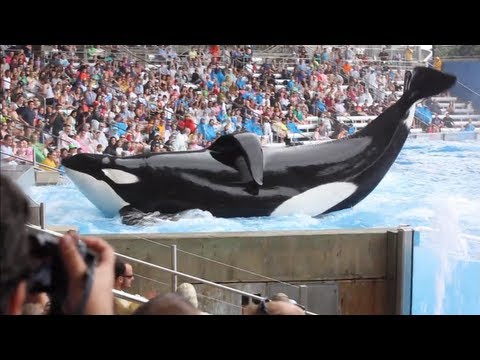
The film’s main focus is on Tilikum, the largest orca currently in captivity, who has been responsible — at least in part — for three deaths since being captured in the wild in the early 1980s. The latest came in 2010 (shortly after another trainer’s death in Loro Parque in Spain in 2009), when head trainer Dawn Brancheau was reportedly pulled underwater by her ponytail after a routine performance at Dine with Shamu in the Orlando park. (The real Shamu died in 1971, which is sort of like finding out that there is no Santa Claus.)
http://www.youtube.com/watch?v=EiT-FQVyoe8
(This video cuts well before anything goes wrong.)
Due to the controversial nature of the film, SeaWorld Entertainment sent out an email to film critics over the weekend that alleges that the allegations made against them in the film are allegedly bogus. You can scroll to the bottom to read the email in its entirety, but in summary, the email warns to take the film as a “powerful, emotionally-moving” direct appeal in advocacy of orca rights but that the film shouldn’t be taken as fact, calling the film “shamefully dishonest”.
The email claims that claims in the film about SeaWorld’s practices — removing orcas from the wild, removing them from their family structure, bullying amongst captive orcas and whether or not the lifespan of a wild orca is significantly longer than a captive orca — are “deliberately misleading” and that what the film “presents as unvarnished reality is anything but.”
On Death at SeaWorld author David Kirby’s blog, he refutes many of the claims SeaWorld has made to refute the claims that Kirby, Cowperthwaite and former trainers Samantha Berg and John Jett have made against them, most notably that SeaWorld had tried to spin the story of Brancheau’s death as trainer error. Kirby writes:
It wasn’t until guest eyewitnesses alerted the media that SeaWorld came out with the “ponytail” theory. But the assertion that Dawn’s ponytail floated into Tilikum’s mouth is neither supported by the video evidence that we have, nor by more than one eyewitness account. It would appear that Tilikum grabbed Dawn by the arm or shoulder. In fact, according to some witnesses, the trainer, Jay Topoleski, who reported the ponytail grab, was not even looking at Dawn when Tilikum took her down.
Of course Blackfish will invariably bring up comparison to The Cove, Louie Psihoyos’s 2009 documentary about the capture and slaughter of dolphins in a secret cove in Japan, and there is good reason for that comparison. But the nature of the incidents in Blackfish make this a trickier, more nuanced subject than the direct approach that Psihoyos was able to make when he captured video of the fisherman in Taiji slaughtering dolphins for not being cute enough to be sold to marine parks.
Obviously SeaWorld is not going to just go away or volunteer to shut down their most famous attractions in exchange for a more tranquil and educational zoo-like park, especially since they became a publicly traded company earlier this year (SEAS).
And because of poor health and bad teeth, the societal structure of orca pods, or having been born in captivity and not having the skills to survive in the wild, many if not most of the captive orcas — including Tilikum — are simply not good candidates for a return to the wild.
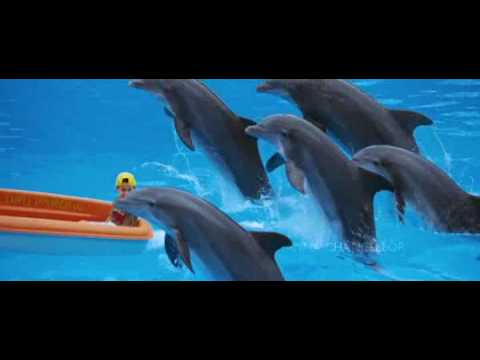
There is also the dirty, shameful truth that SeaWorld is fun (when you don’t know any better) and many people don’t consider the feelings of the orcas after they leave the show. They appear to be so happy and playful during the shows and through the glass. There are tons of family photos in my mom’s albums of us smiling in SeaWorld, me sitting in a little dolphin stroller. I’ve seen Tilikum perform, and teenage me didn’t give as much a damn about movies as he did about being a marine biologist thanks to a swim with dolphins experience. But a positive experience for one isn’t so positive for the other.
The thing is that the expressive eyes and the upcurve both the orca and dolphin have in their mouths make them appear to constantly be happy and smiling. They don’t look lonely or miserable, like a bullied teenager or like a dominated spouse. They look pleased to have done a backflip for some fish. They look playfully mischievous for having splashed you in Shamu Stadium. Those bastards are grinning the whole time!
This, it seems to me, is the biggest problem that orca and dolphin advocates have to overcome. I don’t know how they’ll do it, or if they even can.
Blackfish is tentatively scheduled to open on Friday, August 2nd at the Enzian (but has already been pushed back once by holdovers at the theater) and will air on CNN later this year.
****
Dear Film Critic: I’m writing to you on behalf of SeaWorld Parks & Entertainment. You may be aware of a documentary called “Blackfish” that purports to expose SeaWorld’s treatment of killer whales (or orcas) and the “truth” behind the tragic death of trainer Dawn Brancheau in 2010. In the event you are planning to review this film, we thought you should be apprised of the following. Although “Blackfish” is by most accounts a powerful, emotionally-moving piece of advocacy, it is also shamefully dishonest, deliberately misleading, and scientifically inaccurate. As the late scholar and U.S. Senator Daniel Patrick Moynihan famously noted: “You are entitled to your opinion. But you are not entitled to your own facts.” The film’s most egregious and untrue allegations include: · The insinuation that SeaWorld stocks its parks with killer whales captured from the wild. In fact, SeaWorld hasn’t collected a killer whale from the wild in more than 35 years; more than 80% of the killer whales at SeaWorld were born there or in other zoological facilities. · The assertion that killer whales in the wild live more than twice as long as those living at SeaWorld. While research suggests that some wild killer whales can live as long as 60 or 70 years, their average lifespan is nowhere near that. Nor is it true that killer whales in captivity live only 25 to 35 years. Because we’ve been studying killer whales at places like SeaWorld for only 40 years or so, we don’t know what their lifespans might be—though we do know that SeaWorld currently has one killer whale in her late 40s and a number of others in their late 30s. · The implication that unlike killer whales in the wild, killer whales in zoos or parks—and specifically Tilikum, the whale involved in Dawn Brancheau’s death—are routinely bullied by other whales. The word “bullying” is meaningless when applied to the behavior of an animal like a killer whale. Whales live in a social setting with a dominance hierarchy, both at SeaWorld and in the wild. They express dominance in a variety of ways, including using their teeth to “rake” other whales, in the open ocean as well as in parks. · The accusation that SeaWorld callously breaks up killer whale families. SeaWorld does everything possible to support the social structures of all marine mammals, including killer whales. It moves killer whales only when doing so is in the interest of their long-term health and welfare. And despite the misleading footage in the film, the only time it separates unweaned killer whale calves from their mothers is when the mothers have rejected them. · The accusation that SeaWorld mistreats its killer whales with punishment-based training that’s designed to force them to learn unnatural behaviors. SeaWorld has never used punishment-based training on any of its animals, including Tilikum, only positive reinforcement. And the behaviors it reinforces are always within the killer whale’s natural range of behaviors. · The accusation that SeaWorld trainers were not adequately informed about Tilikum. From the time Tilikum first arrived at SeaWorld, all trainers were warned—both as part of their training and in writing—that they were not allowed in the water with him. In fact, as was widely reported and covered at length in the OSHA proceedings, Tilikum has always had his own set of training protocols and only the most experienced trainers have been allowed to work with him. · The accusation that SeaWorld tried to “spin” the story of Dawn Brancheau’s death, changing its story several times and blaming her for the tragedy. As the movie itself shows, it was local law enforcement—not SeaWorld—that issued the initial report that Dawn had accidentally fallen into the water. SeaWorld’s account of what happened—that Tilikum had grabbed Dawn’s ponytail and pulled her in—never varied. And the company has never blamed Dawn for what happened. (The person in the film who did was not a SeaWorld spokesperson.) · The assertion that Tilikum attacked and killed Dawn Brancheau because he was driven crazy by his years in captivity. Tilikum did not attack Dawn. All evidence indicates that Tilikum became interested in the novelty of Dawn’s ponytail in his environment and, as a result, he grabbed it and pulled her into the water. These are only the most egregious of the film’s many misrepresentations. “Blackfish” is similarly misleading and inaccurate in its account of the other fatal incidents in which Tilikum was supposedly involved, what happened at Loro Parque, the training and qualifications of SeaWorld trainers, and the care and living conditions enjoyed by SeaWorld’s orcas. And the list goes on
and on. SeaWorld is proud of its legacy of supporting marine science and environmental awareness in general and the cause of killer whales in particular. Our point in sending you this note is to make you aware that what “Blackfish” presents as unvarnished reality is anything but. We don’t expect this to settle the debate, but rather we hope it will begin one. If you are interested in learning more, please contact Fred Jacobs.
This article appears in Jul 17-23, 2013.